
Note: This case study includes design-complete work for internal enterprise tools. Screens and data have been anonymized and modified to protect confidentiality.
Recovering revenue from damaged inventory
Lead Product Designer | 3 months
UX Research · Product Design · Interaction Design · Accessibility · Prototyping
Tools used: Figma, Miro, Figma DevMode, HTML/CSS
The Problem
Supplier credits are reimbursement claims for damaged, spoiled, or unsellable inventory. Unlike Distribution Center (DC) credits, they do not require reason codes or photo documentation, making speed and accuracy critical to the submission process.
Fresh associates struggled to submit and manage supplier credits due to limited visibility, manual workarounds, and inefficient claim workflows.
The Solution
Redesigned the supplier credit experience, enabling associates to scan, review, edit, submit, and modify claims with greater accuracy and efficiency.
Impact

Users = Fresh associates, Backroom associates, & Suppliers

Primary Users
Fresh associates identified damaged or spoiled inventory and submitted supplier reimbursement claims.
Secondary Users
Backroom receiving associates supported receiving operations and supplier credit workflows.
Business Stakeholders
Suppliers and inventory operations teams relied on accurate claims to process reimbursements and maintain inventory accuracy.
The Problem = Credit submission was slow & error prone
The existing supplier credit process required associates to navigate multiple screens, manually verify information, and restart workflows whenever changes were needed.
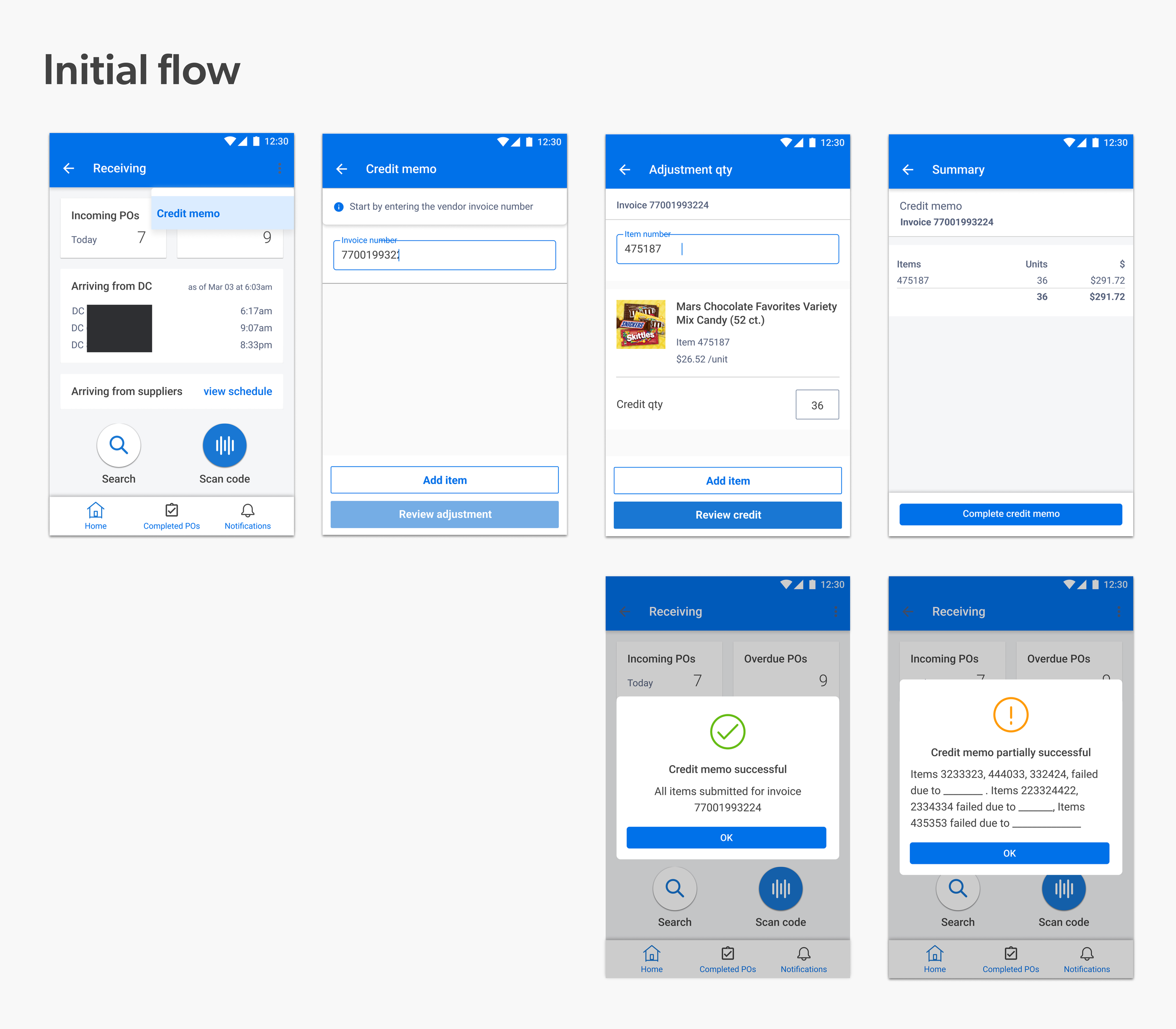
Key challenges
No visibility into submitted items before filing a claim, or post-submission claim statuses
No easy way to edit quantities, correct mistakes, or add items without restarting the workflow
No barcode scanning within the flow for item detection
Item imagery frequently failed to load
Heavy reliance on manual entries
Core insight
Users needed a flexible workflow that allowed them to continuously add items, make corrections before submission, and track supplier credit status after filing.
Research & Discovery
Understanding existing workflows
To understand the challenges associates faced, I partnered with store teams and operational stakeholders to observe current processes and identify friction points.
Research methods
Store visits
Contextual inquiry
Associate interviews
Workflow audits of current and adjacent processes
Whiteboarding workshops
Process mapping
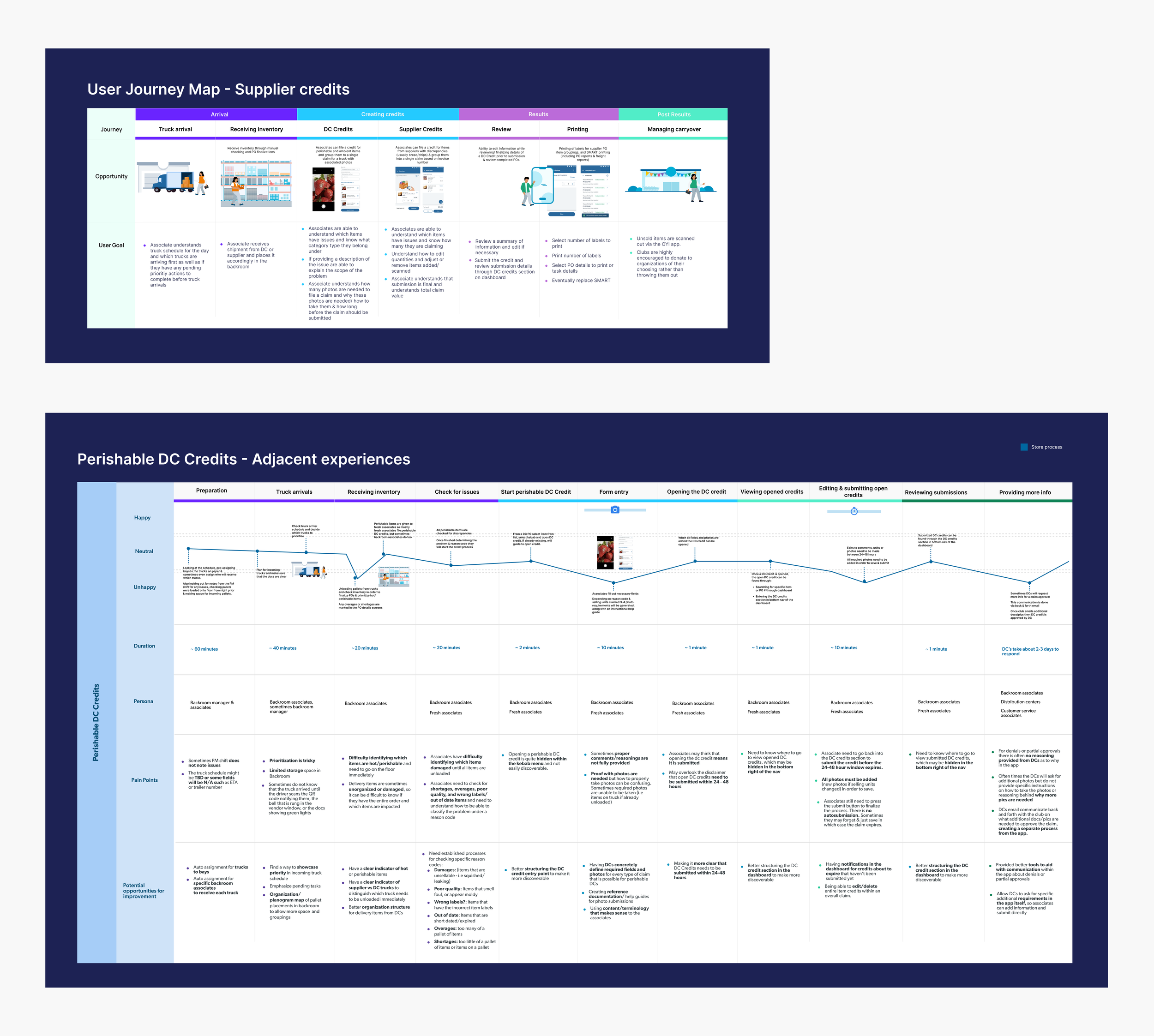
Supplier credit process & adjacent credit experience journey maps
Key findings
Editing Required Restarting Work
Associates frequently exited workflows to make modifications.
Scanning was unavailable
Slow item retrieval increased claim creation time.
Visibility Was Limited
Users couldn't easily verify submissions or approval status.
Opportunity
Create a review-first workflow that allows associates to:
Continuously add items
Edit quantities before submission
Review claim details in one place
Track supplier credit status after filing
Reduce submission errors and rework
Design strategy
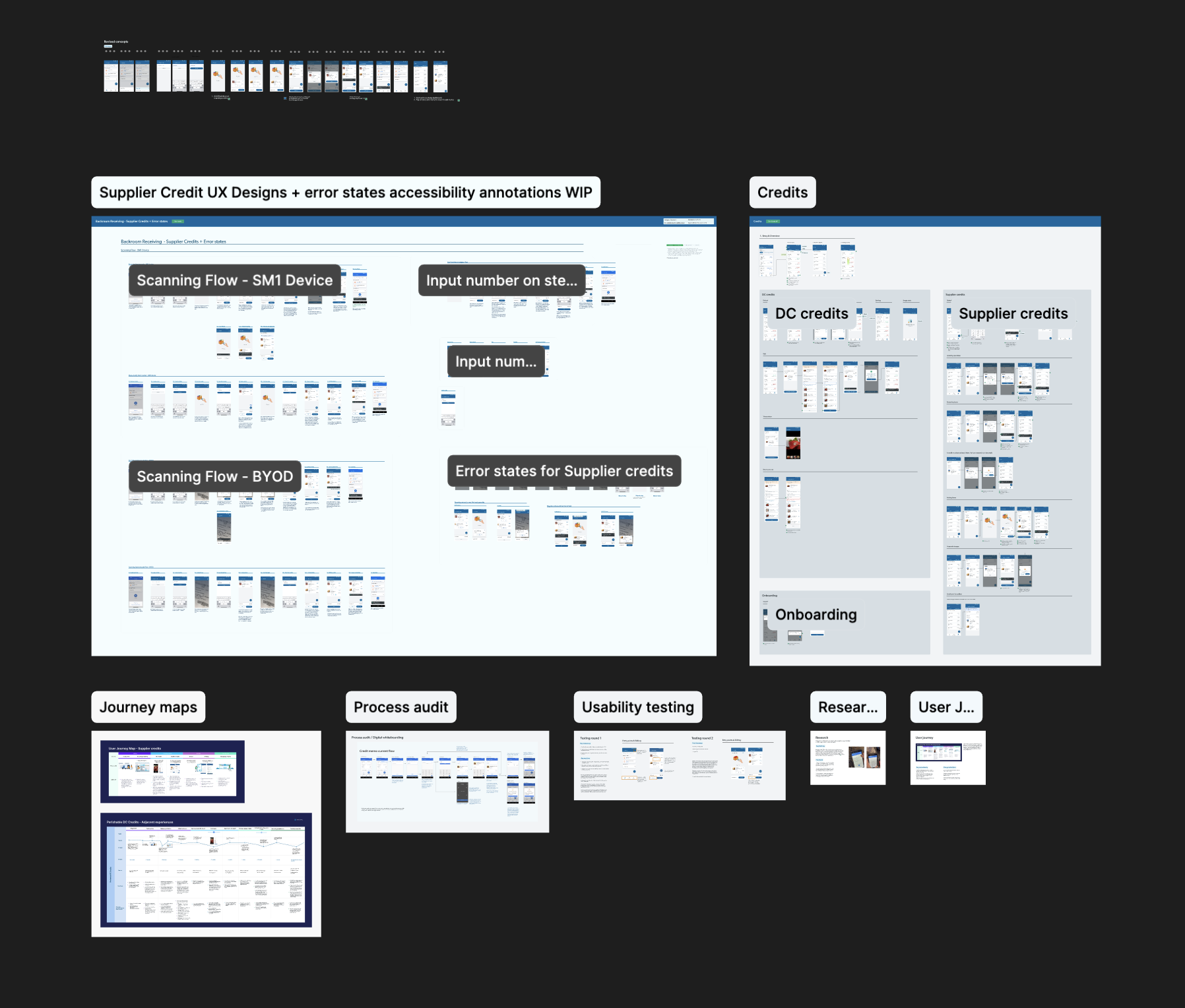
Research → Process Audit → Journey Mapping → Concept Exploration → Iteration → Final Solution
Review Before Submission
Allow associates to verify and correct information before filing.
Progressive Disclosure
Present only the information needed at each step.
Continuous Claim Building
Support adding and editing items without restarting the workflow.
Visibility & Confidence
Keep key claim details visible throughout the process.
Speed Through Context
Enable faster submissions through scanning and streamlined editing.
Design evolution
From submission → review → confidence
The workflow evolved from a rigid submission process into a flexible review-first experience focused on reducing errors and improving visibility.
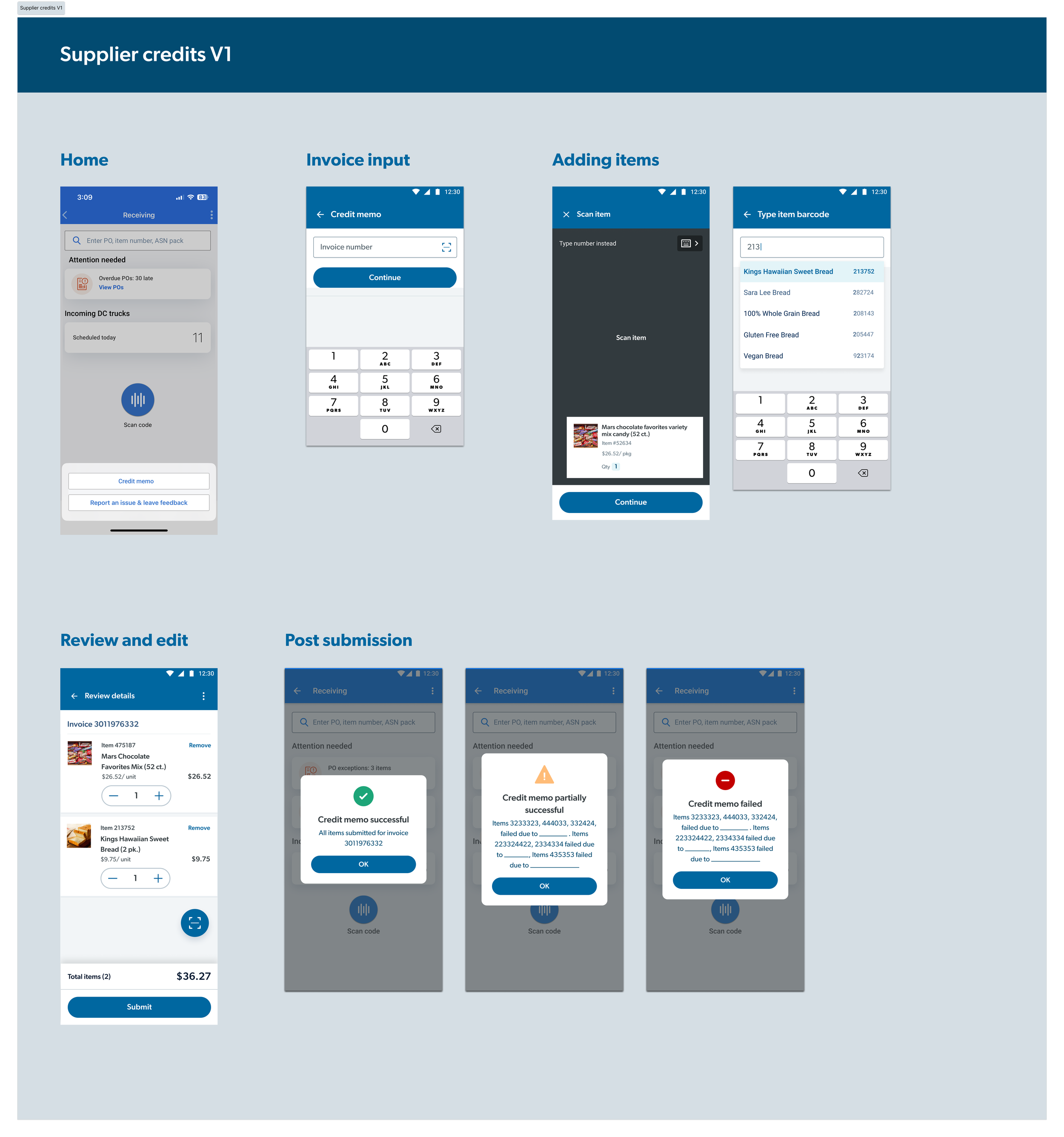
V1 — Credit Creation & Review
Goal: Improve the supplier credit workflow and provide a clear path for creating, reviewing, and submitting claims.
Introduced
Invoice-based credit creation
Item scanning and manual barcode lookup
Inline quantity editing
Review before submission
Success, partial success, and failure states
✅ Outcome: Simplified supplier credit creation and submission while revealing usability issues around accidental edits, workflow flexibility, and post-submission visibility.
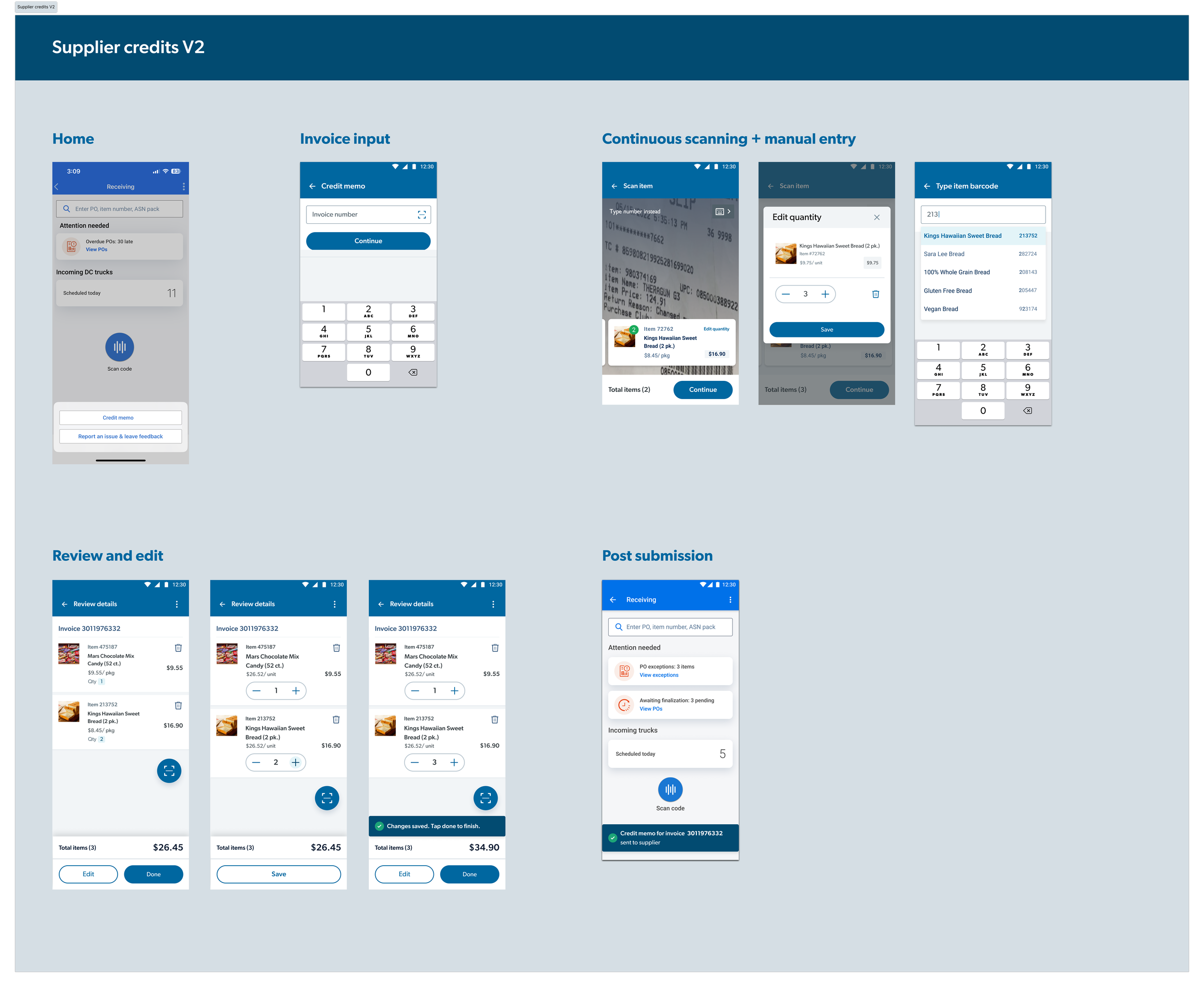
V2 — Intentional Editing
Goal: Reduce accidental claim modifications while improving confidence during review.
Introduced
Continuous scanning and claim building
Dedicated edit mode for quantity adjustments
Separated review and edit actions
Improved visibility into claim details and totals
✅ Outcome: Reduced accidental quantity changes and enabled associates to review and correct claims with greater confidence before submission.
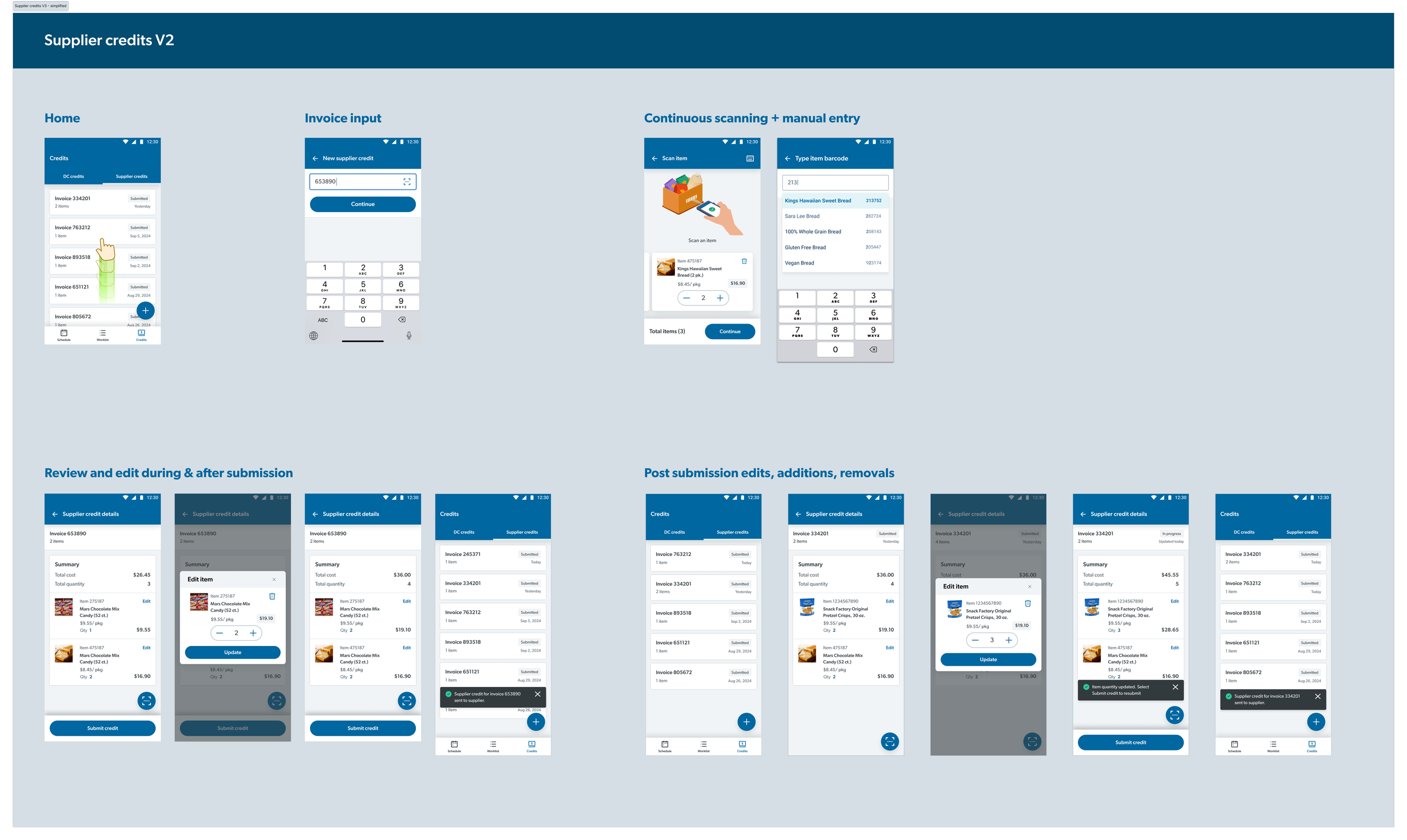
V3 — Claim Management & Post-Submission Visibility
Goal: Extend supplier credits beyond submission and support ongoing claim management.
Introduced
Supplier credit history and status tracking
Submitted-credit detail views
Dedicated edit modal for claim modifications
Post-submission additions, edits, and removals
Enhanced item imagery, summary hierarchy, and confirmation
✅ Outcome: Improved visibility into submitted claims and enabled associates to manage supplier credits throughout the claim lifecycle without relying on external coordination.
Final solution
Designing a Flexible Supplier Credit Experience
Continuous Claim Building — Scan, add, and review items without restarting the workflow.
Intentional Editing — Separate review and edit actions to reduce accidental changes.
Claim Management — View and manage submitted credits, including adding, adjusting, or removing items.
Improved Visibility — Surface key claim details and status throughout the process.
Note: This case study focuses on supplier credit workflows. Distribution Center (DC) credits followed a separate user journey and are not included. Filtering was considered for future iterations but excluded from the MVP to prioritize core claim creation, review, and management experiences.
Business Goals Achieved
Operational Efficiency
Reduced workflow friction by eliminating unnecessary restarts and manual workarounds.
Accuracy
Improved claim quality through review and editing capabilities before submission.
Visibility
Increased transparency into claim details, quantities, and item information.
Scalability
Established a foundation supporting a workflow responsible for 220K+ supplier credits annually.
Reflection
Visibility Improves Accuracy
Users make better decisions when they can review information before committing.
Operational Workflows Require Flexibility
Associates frequently need to make adjustments while working in fast-paced environments.
Small Friction Creates Large Costs
A few extra interactions become significant inefficiencies when performed thousands of times across stores.