
Note: This case study includes a mix of shipped and design-complete work for internal enterprise tools. Screens and data have been anonymized and modified to protect confidentiality.
A Single Source of Truth for Receiving Operations Across 500+ Stores
Lead Product Designer | 2023–2024
UX Research · Product Design · Interaction Design · Accessibility · Prototyping
Tools used: Figma, Miro, Figma DevMode, HTML/CSS
The problem: Receiving teams relied on disconnected schedules and legacy tools, making it difficult to track incoming trucks, purchase orders, and unload status in real time.
The solution: Designed a truck visibility platform that unified scheduling, purchase orders, and unload tracking into a single operational workflow.
Impact

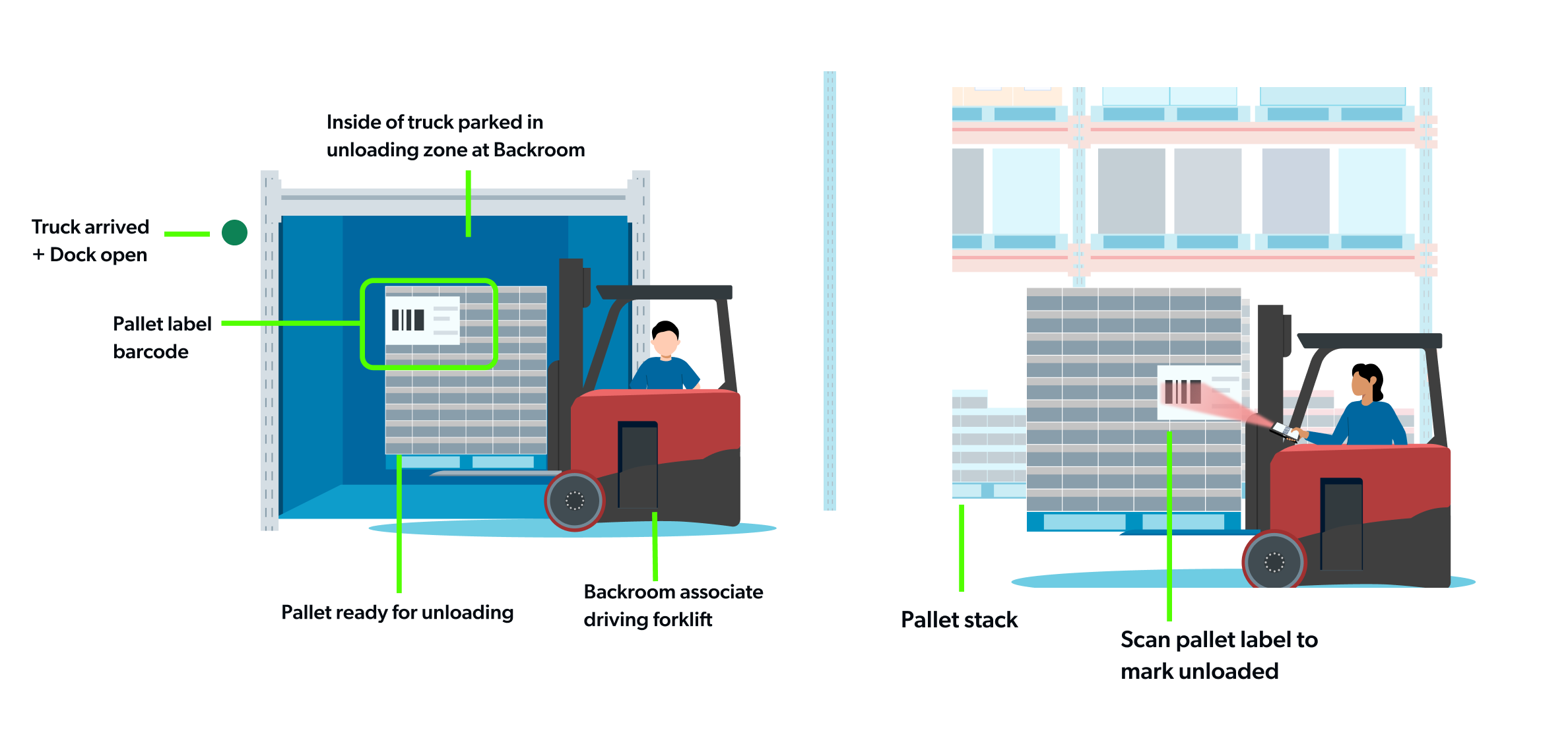
Users = Backroom receiving associates
Receiving associates manage incoming freight, unload trucks, and verify purchase orders to maintain accurate inventory.
They work in fast-paced environments where efficiency, clear communication, and real-time visibility into truck activity are critical to daily operations.
The Problem = Disconnected Tools
Receiving operations relied on three disconnected systems:
Printed truck schedules
Desktop scheduling tools
Legacy mobile applications
Associates frequently switched between systems to understand truck schedules, arrivals, unload progress, and completion status.
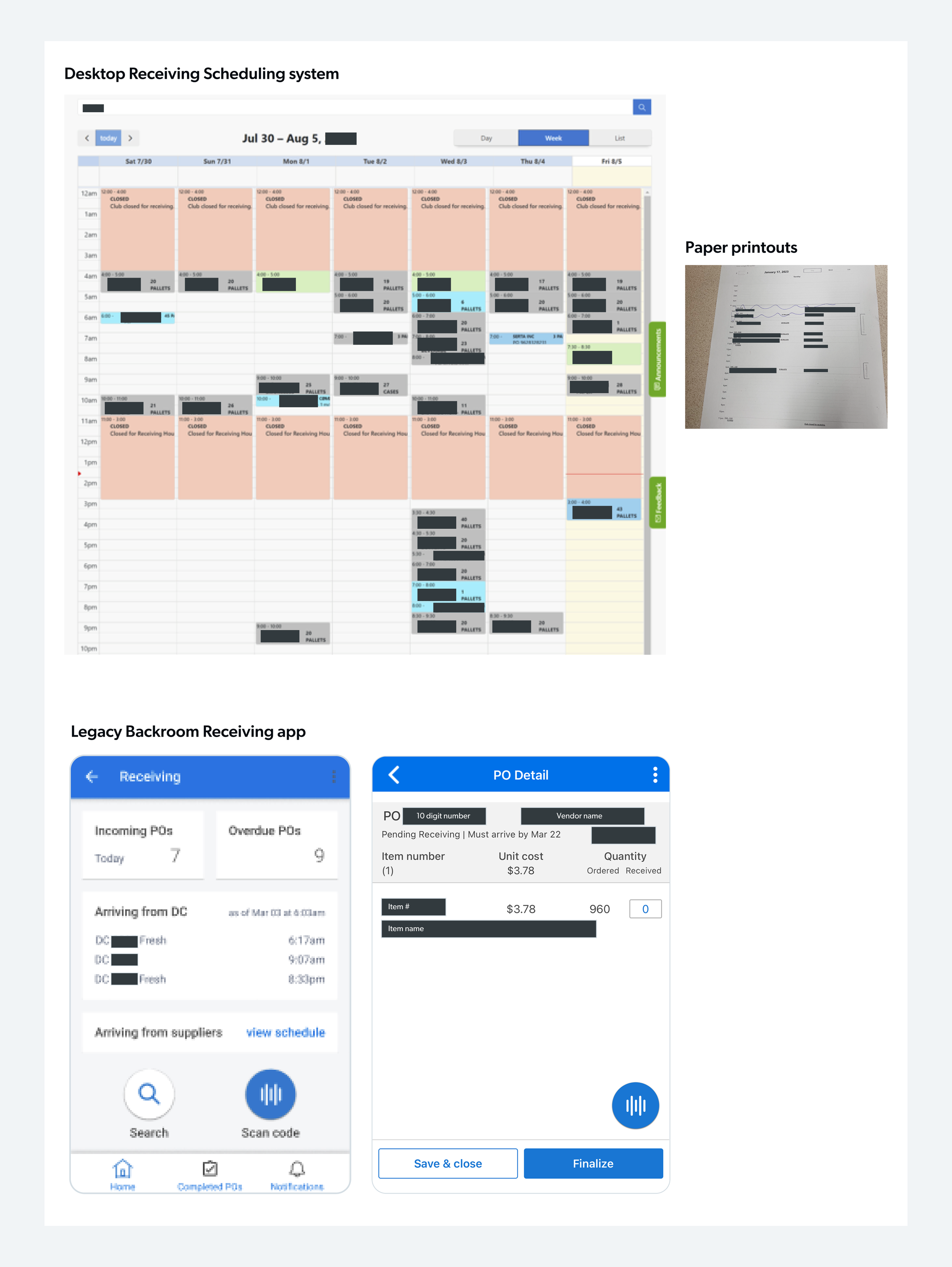
Key challenges
Fragmented workflows across paper, desktop, and mobile tools slowed receiving operations
Missing real-time updates made schedule changes difficult to manage
Limited visibility into purchase orders and unload status created communication gaps and inventory inaccuracies
Manual reconciliation was required to track truck completion across systems
Core insight
Associates didn't need another scheduling tool.
They needed a single source of truth connecting planning, unloading, purchase orders, and completion tracking across the receiving lifecycle.
Research & Discovery
To better understand receiving operations, I conducted field research directly within receiving environments.
Research methods
Onsite observations across 5 locations
Contextual interviews with receiving associates
End-to-end workflow walkthroughs
AM and PM shift shadowing
Iterative usability testing
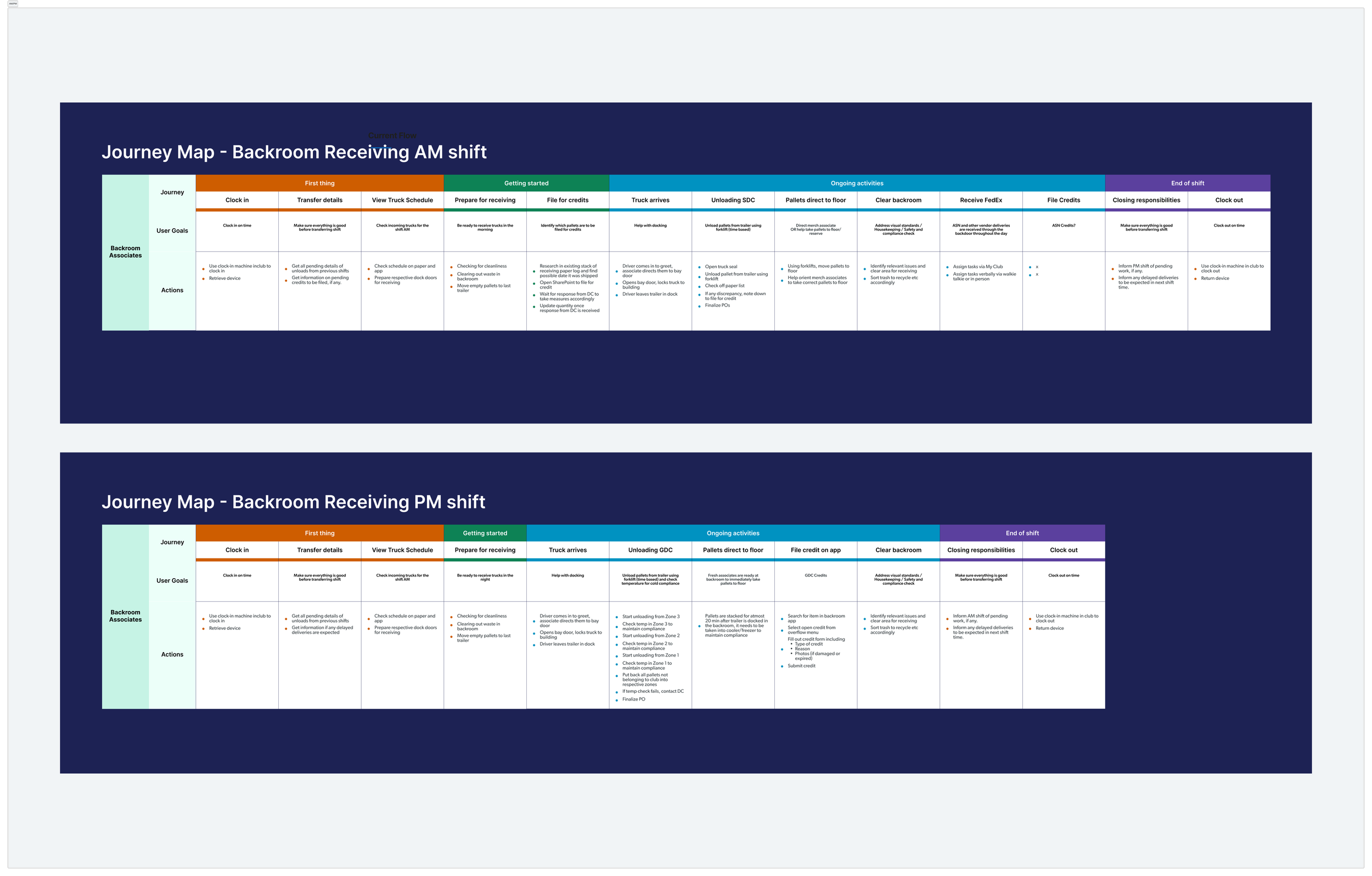
AM & PM End-to-End Backroom Receiving Journey maps
Key findings
Schedules changed constantly
Late arrivals, no shows and reschedules quickly made printed schedules unreliable.
Completion status was unclear
Associates struggled to determine which trucks had been fully unloaded and finalized.
Communication gaps slowed operations
Critical updates were often passed verbally or through hand written notes.
Visibility drove decision making
Associates needed a real-time understanding of what was scheduled, arrived, unloading and complete.
Transition to design
These findings highlighted the need for a system that supported both forward planning and real-time execution, making truck arrivals, purchase orders, unload status, and completion easy to track and communicate across shifts.
Design principles
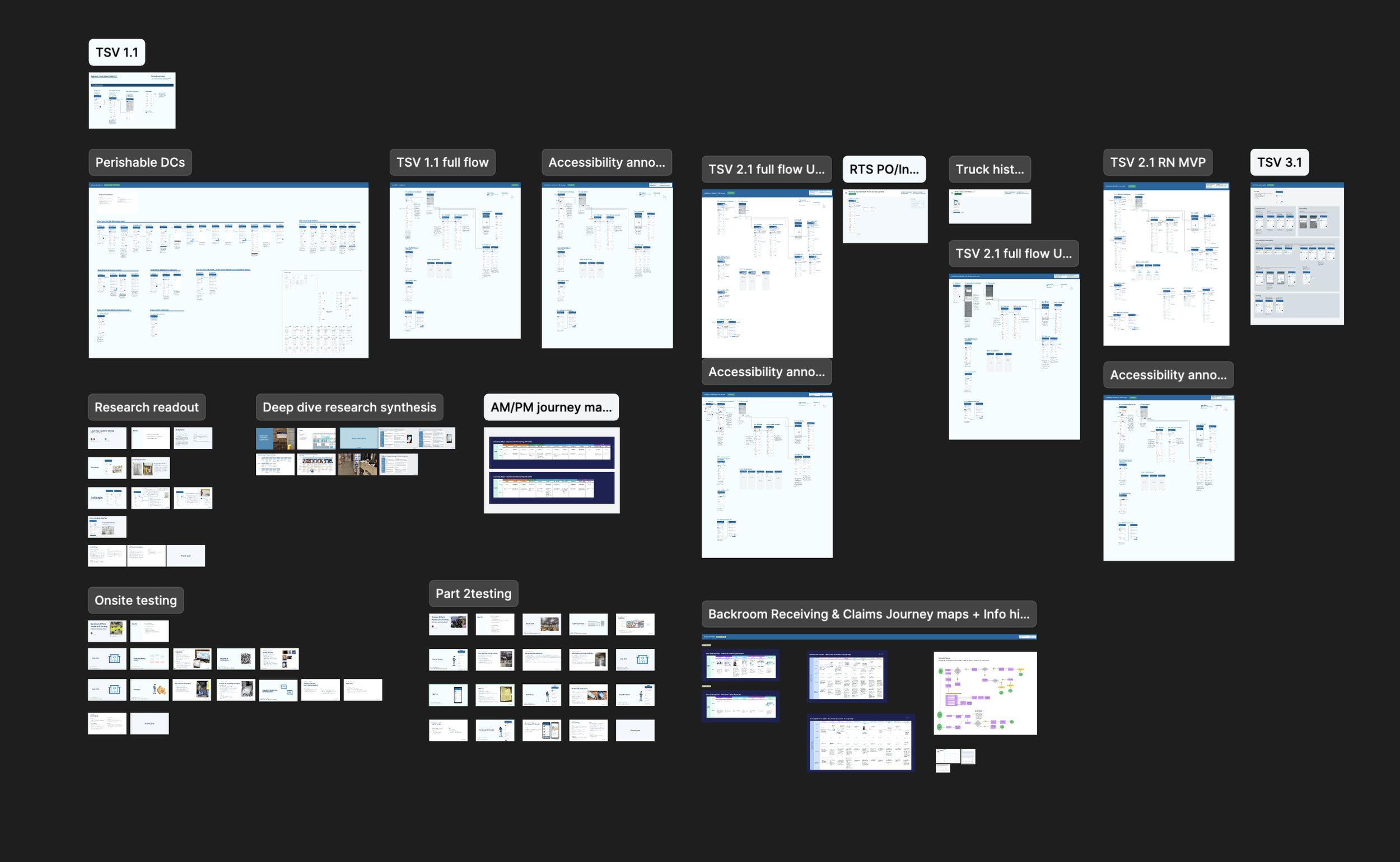
Research → Journey Maps → Concepts → Iterations → Final Solution
Single source of truth
One operational view across scheduling unloading and completion.
Designed for change
Support real-time schedule updates and operational disruptions.
Fast to scan
Optimize information hierarchy for high-volume receiving environments.
Built for shift continuity
Ensure progress remains visible across teams and shifts.
Design evolution
From visibility → execution → automation
What began as a truck visibility solution evolved into a broader operational platform supporting planning, execution, and automation across the receiving lifecycle.
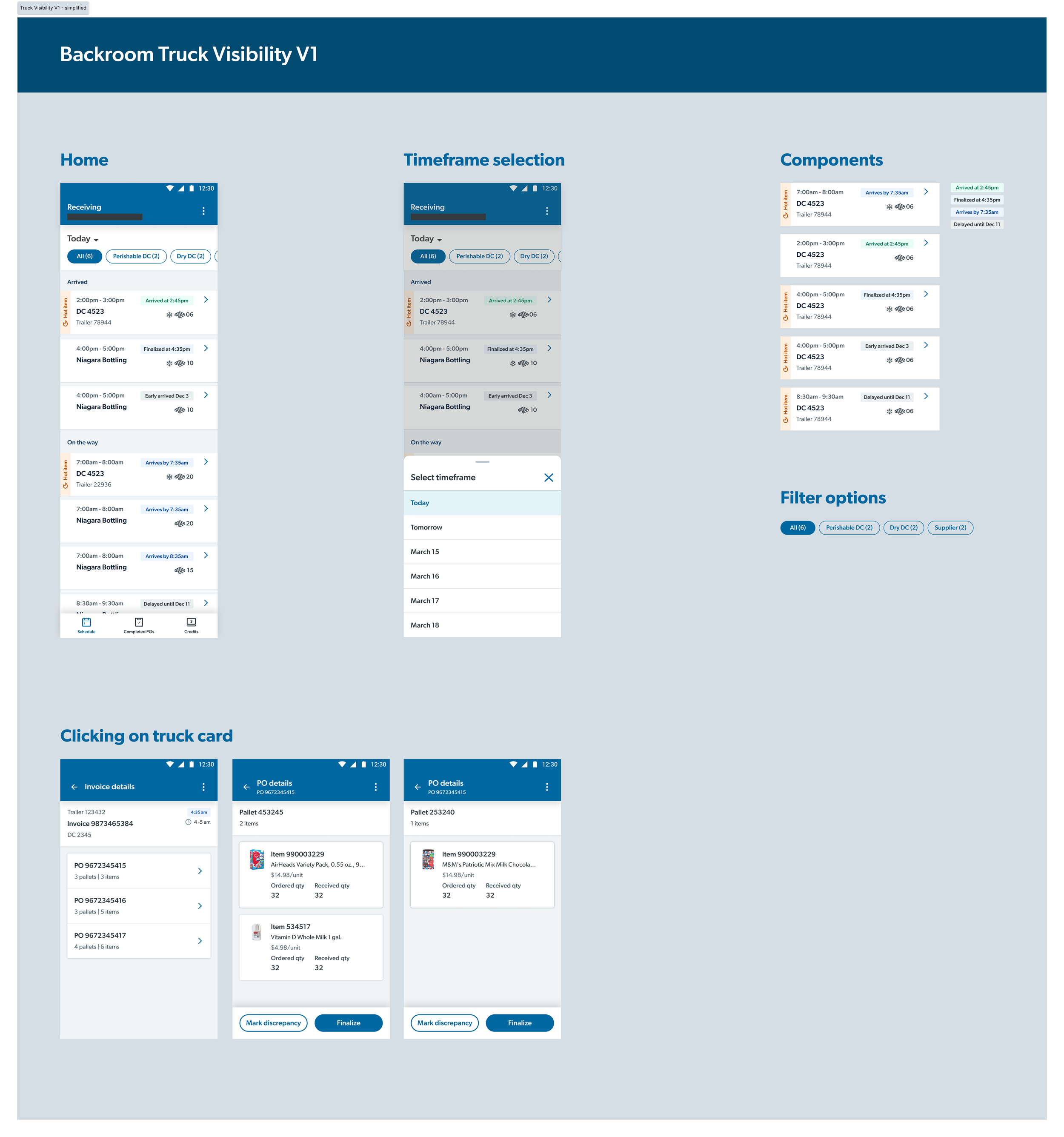
V1 — Visibility
Goal: Replace paper schedules with a shared digital view of incoming trucks.
Introduced
Arrived and On the Way truck states
ETA, Source: DC/vendor, pallet count, and hot item visibility
Filters for truck type and delivery status
Purchase Order drill-downs and truck finalization
Short-term planning for upcoming deliveries (today → next few days)
✅ Outcome: Established a reliable digital schedule, improved visibility into upcoming deliveries, and revealed gaps in completion tracking and change management.
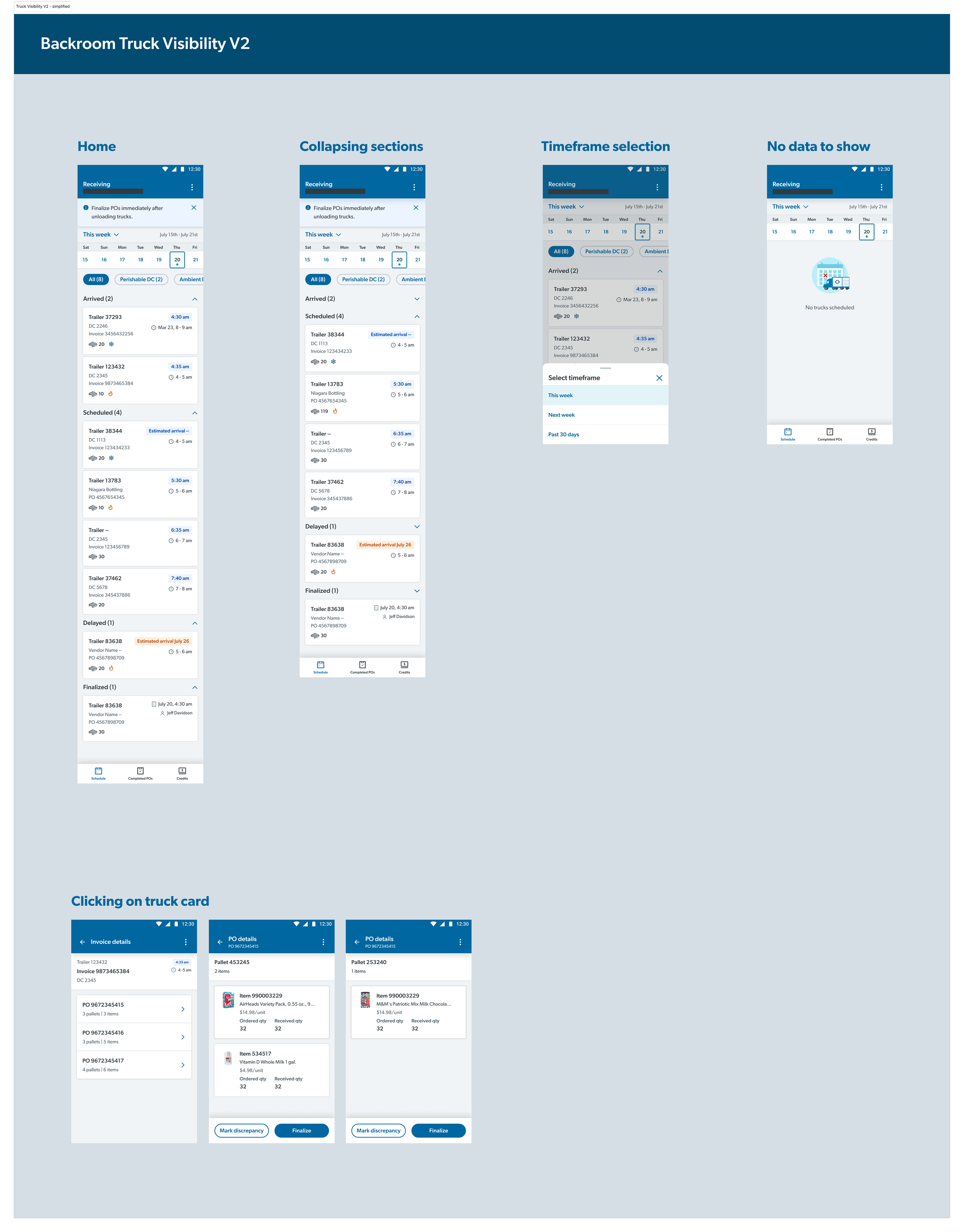
V2 — Execution
Improvements
Added an explicit Finalized truck states
Automatically grouped completed trucks
Introduced weekly planning views
Improved schedule sorting and operational guidance
✅ Outcome: Increased visibility into truck completion and improved planning across shifts.
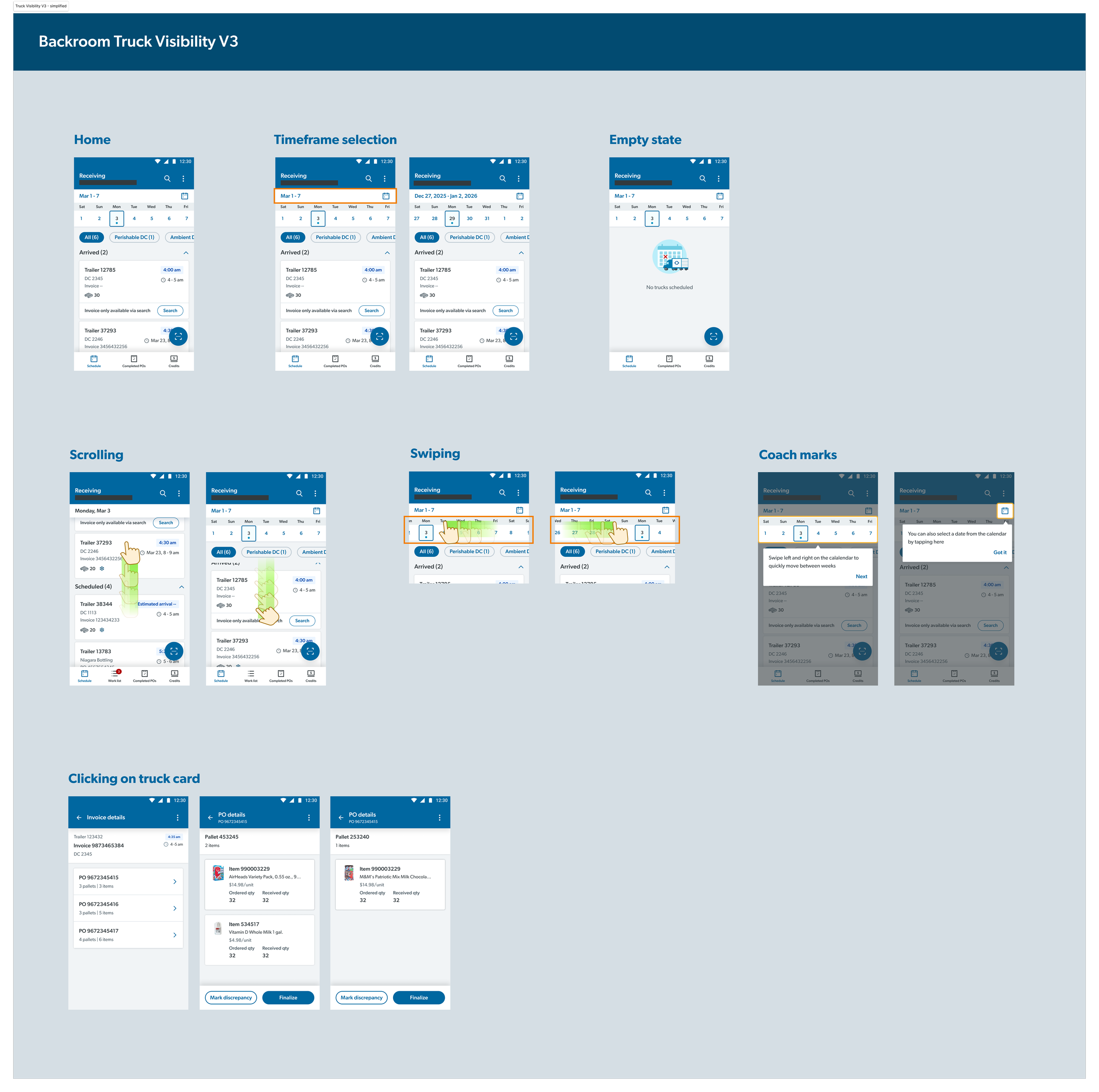
V3 — Automation & usability
Improvements
Simplified date navigation
Added swipe interactions and scrolling enhancements
Introduced coach marks for discoverability
Reduced manual workflow friction
✅ Outcome: Faster scanning, smoother navigation, reduced cognitive load during daily receiving operations.
Final solution
A Unified Receiving Platform
The final experience consolidated:
Truck scheduling
Purchase order visibility
Arrival tracking
Unloading workflows
Truck finalization
Cross-shift communication
into a single operational platform supporting both planning and execution.
The dashboard provides associates with prioritized operational information while allowing deeper investigation through scheduling views, truck status, and purchase order details.
Note: This prototype includes later enhancements such as scan-to-unload pallets, truck unloading status, and worklist workflows, illustrating how the initial truck visibility and purchase order foundation evolved into a broader receiving platform.
Business Goals Achieved
Adoption
Scaled across 500+ stores and replaced paper-based workflows.
Engagement
Integrated directly into daily receiving operations.
Trust
Created a single source of truth across receiving systems.
Operational efficiency
Reduced manual coordination by 70%+ improving visibility into truck arrivals, unload status, and PO completion tracking.
Scalability
Established a foundation for future receiving workflows.
Reflection
Research changed the direction
Field observations revealed the problem wasn't scheduling—it was visibility.
Iteration drove adoption
Each release improved planning, execution, and communication, transforming the product from a scheduling tool into a foundational operational platform.
Building for scale
What began as a truck visibility solution evolved into a scalable framework supporting broader receiving and operational workflows.